Technical innovation, the engine of the energy transition
ELECRO's R&D activity is built around a Corporate Shared Value (CSV) principle: economic value for investors and social value for communities are produced through the same set of operational activities. Access to clean energy and local energy efficiency are addressed as business-model variables.
Our philosophy
Applied R&D and Corporate Shared Value
ELECRO operates as a solar EPC integrator, and applied research and development is the function that reduces the technology risk a B2B client would otherwise carry. Every solution we recommend is technically validated before being integrated into a project, not merely resold from a supplier’s catalogue. That is, for us, the operational definition of innovation.
The Corporate Shared Value model (formulated by Porter and Kramer) is our framework for prioritising decisions: we select research directions and community projects at the intersection of economic return and measurable social benefit. Responsibility is not an image cost line separate from the business, but an operational extension of our core activity.
The framework materialises in three interdependent directions: applied research and development on photovoltaic and storage technologies; a circular economy anchored in resource efficiency and in the material flows of the equipment we install; and capacity building — training the technical workforce the energy transition depends on, with an explicit commitment to social inclusion.
Applied R&D, anchored in real projects
Corporate Shared Value model (Porter & Kramer)
Circular economy through resource efficiency and asset longevity
Capacity building for the transition workforce
The four pillars
How innovation translates into practice
Four distinct work streams, connected by the same principle: technical competence used both for project performance and for community impact.
Under development
Applied Research & Development
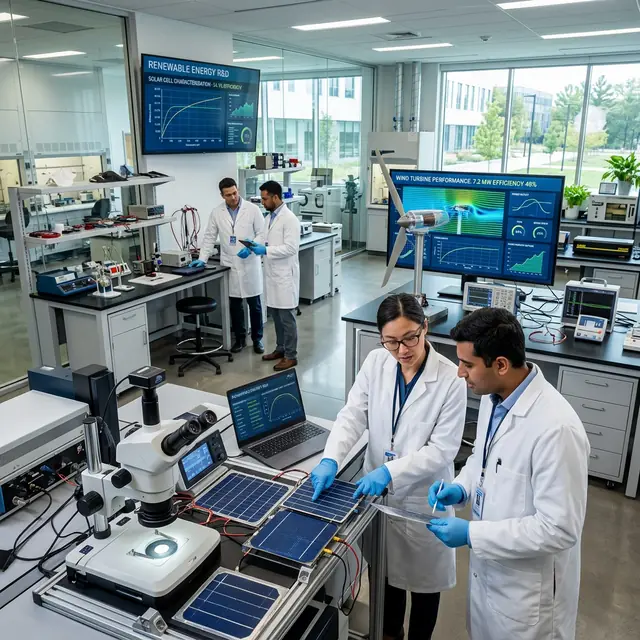
We are building a pilot testing hub where we calibrate photovoltaic and storage solutions at small scale before integrating them into clients’ large projects. The aim: we take on the risk of primary testing so that B2B clients receive only mature, practically verified technologies. The hub is under development — we publicly communicate only capabilities that are genuinely operational.
Strategic direction
Circular Economy & Resource Efficiency
A strategic direction along three concrete axes, beyond conventional solar: asset longevity through bankable, durable equipment and O&M (preventive maintenance, cleaning) that maximises useful life; reconversion of degraded/brownfield land, without occupying agricultural land; and designing equipment for disassembly (design-for-disassembly), routing end-of-life components to authorised WEEE operators.
Community
Community Projects & Eco-Friendly Engineering
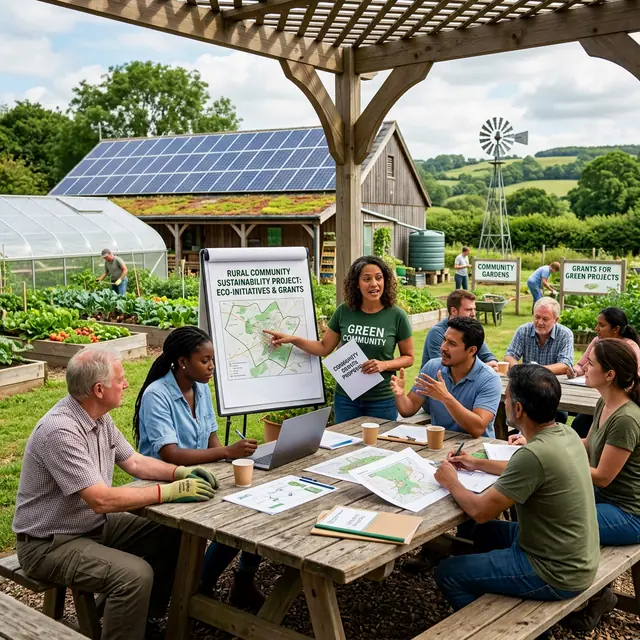
We put our technical expertise to work on green-energy projects for public spaces, local communities and vulnerable groups. We provide consultancy services within non-reimbursable grant funding schemes (national and European) aimed at energy efficiency — from the technical case for the project through to the application documentation. We will publicly present only projects actually under contract, with verifiable results.
Education
ELECRO Future — Capacity Building & Inclusion
We prepare the generation of specialists the transition depends on: mentoring programmes, applied workshops and technical conferences for young engineers, being developed together with vocational high schools, professional associations and universities. We aim to facilitate access to technical training and to jobs for people from disadvantaged social backgrounds — apprenticeship and professional integration in renewable-energy trades (installation, O&M). We will announce partners and the event calendar as agreements are signed.
In detail
The circular economy, concretely defined
We define circular economy operationally, through quantifiable material flows and life-cycle resource efficiency, not as a declarative goal. For ELECRO the direction rests on three concrete angles, in Corporate Shared Value logic: asset longevity, territorial circularity, and design for disassembly — all anchored in the equipment we install and operate.
The longevity component treats every asset as a material resource that O&M preserves: selecting bankable equipment with extended warranties, preventive/corrective maintenance and cleaning maximise useful life and yield, thereby reducing materials and waste per MWh produced over the lifetime. The territorial component places photovoltaic capacity on degraded/brownfield land, refunctionalising the space without occupying agricultural land. The design component intervenes at the engineering stage, through material separability and component recovery at end of life, routed to authorised (WEEE) operators; ELECRO designs for this purpose, it does not operate recycling.
Longevity through O&M: maximising useful asset life, less waste per MWh
Brownfield reconversion: PV capacity on degraded land, no agricultural land
Design-for-disassembly and routing of components to authorised (WEEE) operators
ELECRO's activity contributes directly to the Sustainable Development Goals (SDGs), with targets verified against the official UN source. We select only the goals directly applicable to our profile as an EPC/EPCM integrator, O&M provider and capacity builder.
SDG 7 — Affordable and Clean Energy
Targets 7.2 (increasing the renewable share) and 7.3 (energy efficiency). We develop and execute EPC/EPCM photovoltaic capacity that adds renewable generation directly to the energy system.
SDG 13 — Climate Action
Targets 13.2 and 13.3. Every MW of photovoltaic installed and operated displaces fossil-fuel generation, reducing the CO₂ emissions of clients and of the system.
SDG 12 — Responsible Consumption & Production
Targets 12.2 (efficient resource use) and 12.5 (waste reduction through reuse). O&M maximises asset lifetime, while responsible equipment selection reduces waste across the life cycle.
SDG 15 — Life on Land
Targets 15.3 (land-degradation neutrality) and 15.5 (habitat protection). We prioritise degraded/brownfield land and conduct environmental permitting, including Natura 2000 assessments.
SDG 8 — Decent Work and Growth
Targets 8.5 (productive employment) and 8.8 (safe working environments). We create skilled technical jobs in construction and operation and apply HSE procedures on photovoltaic sites.
SDG 4 & 10 — Education and Inclusion
Targets 4.4 (technical skills), 4.7 (education for sustainability) and 10.2 (social inclusion). We aim to train renewable-energy specialists and to facilitate access to training and jobs for people from disadvantaged backgrounds.
Have a technical requirement or a project to assess?
Whether it is technical validation of a photovoltaic solution, a grant-funded community project or a capacity-building partnership, we work from specifications and concrete data.